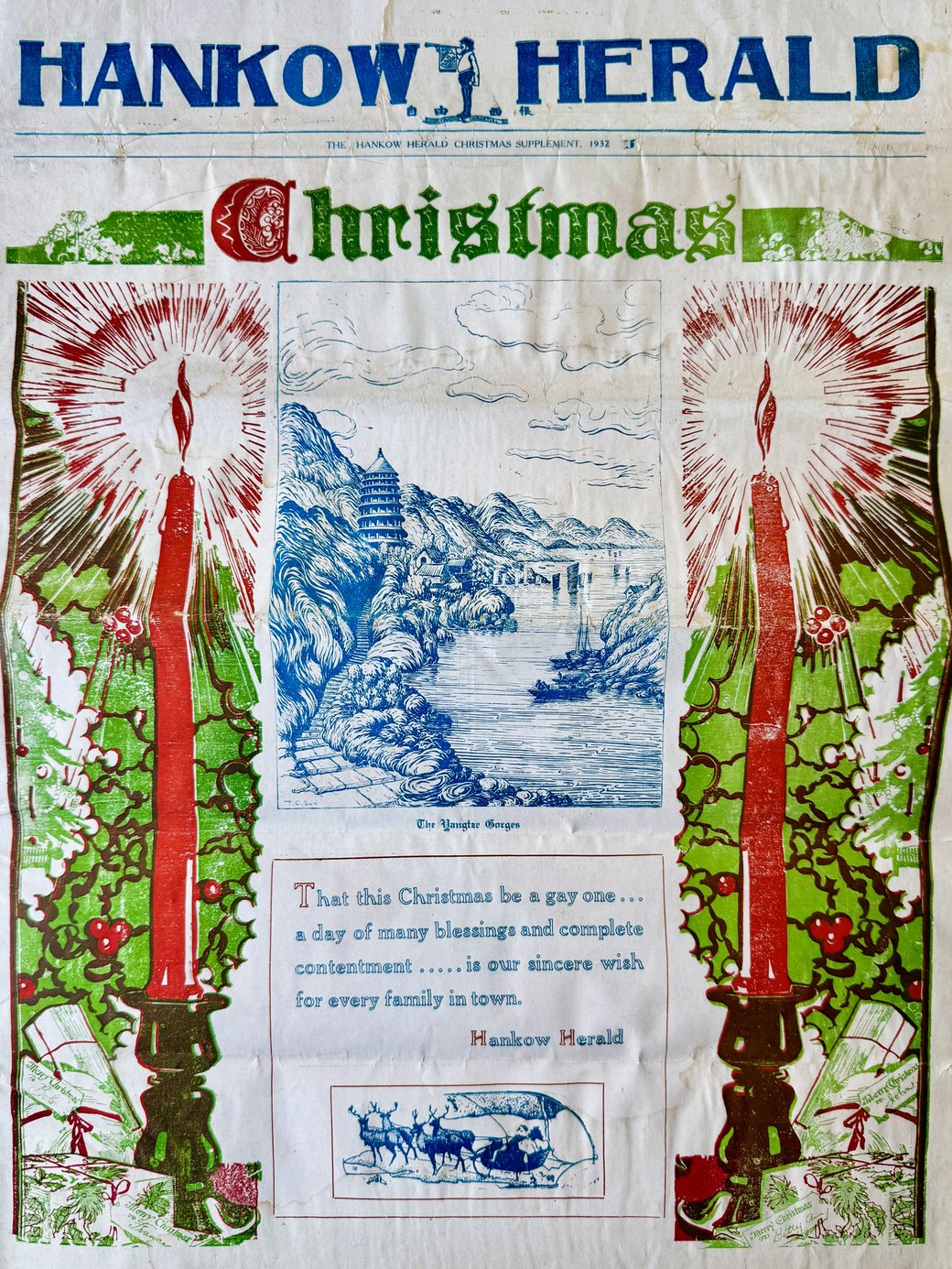
Printed at the height of Hankow’s treaty-port era, this 1932 Christmas supplement of the Hankow Herald from our collection depicts a city shaped by foreign concessions, international and local banks, and a distinctive blend of expatriate and Chinese urban culture along the Yangtze.


Hankow, today part of modern Wuhan, was opened to foreign trade after the Second Opium War. The British concession, established in 1861, was the first and largest, created to secure trade, shipping, and extraterritorial rights along the Yangtze. It was followed by the German concession (1895) after China’s defeat in the Sino-Japanese War, the Russian and French concessions (both 1896) tied to expanding imperial influence and commerce, and the Japanese concession (1898) reflecting Japan’s growing economic and political power in central China.

These concessions formed semi-autonomous districts where foreign merchants, bankers, missionaries, and officials lived and worked. Because of its concentration of banks, trading houses, and financial institutions, Hankow was widely known at the time as the “Chicago of the East.”
Founded in 1923, the American-owned "Hankow Herald" together with the British "Central China Post" were Hankow’s main English-language newspapers, read by British, American, European, and Japanese residents, as well as Chinese merchants dealing with foreign firms.

The 1932 Christmas edition of the Hankow Herald blends Western seasonal imagery - candles, holly, Santa Claus - with a Chinese view of the Yangtze Gorges, symbolizing the hybrid culture of the city. By this time most concessions had formally ended, yet the foreign business community remained active, and the Hankow Herald continued to serve as its central voice. The issue was filled with local advertisements from banks, department stores, cinemas, drug stores, tailors, garages & car dealers, retail shops for flowers, books, arts, electric appliances, jewelry, toys & musical instruments and of course - cigarettes.


Write a comment